- Project promoter: Administative-Territorial Unit Dâmbovița County
- Project partners: Horten Marsjklubb – Norway, EuroTrainer Association – Romania
- Project total value: 23,972,786.94 lei (4,872,913.84 Euros)
- Non-reimbursable financing (85% from EEA Grant and 15% from the national budget): 9,202,231.84 lei (1,870,524.40 Euro)
- Project duration: 35 months
- Project location: Târgoviște, Dâmbovița County, Romania
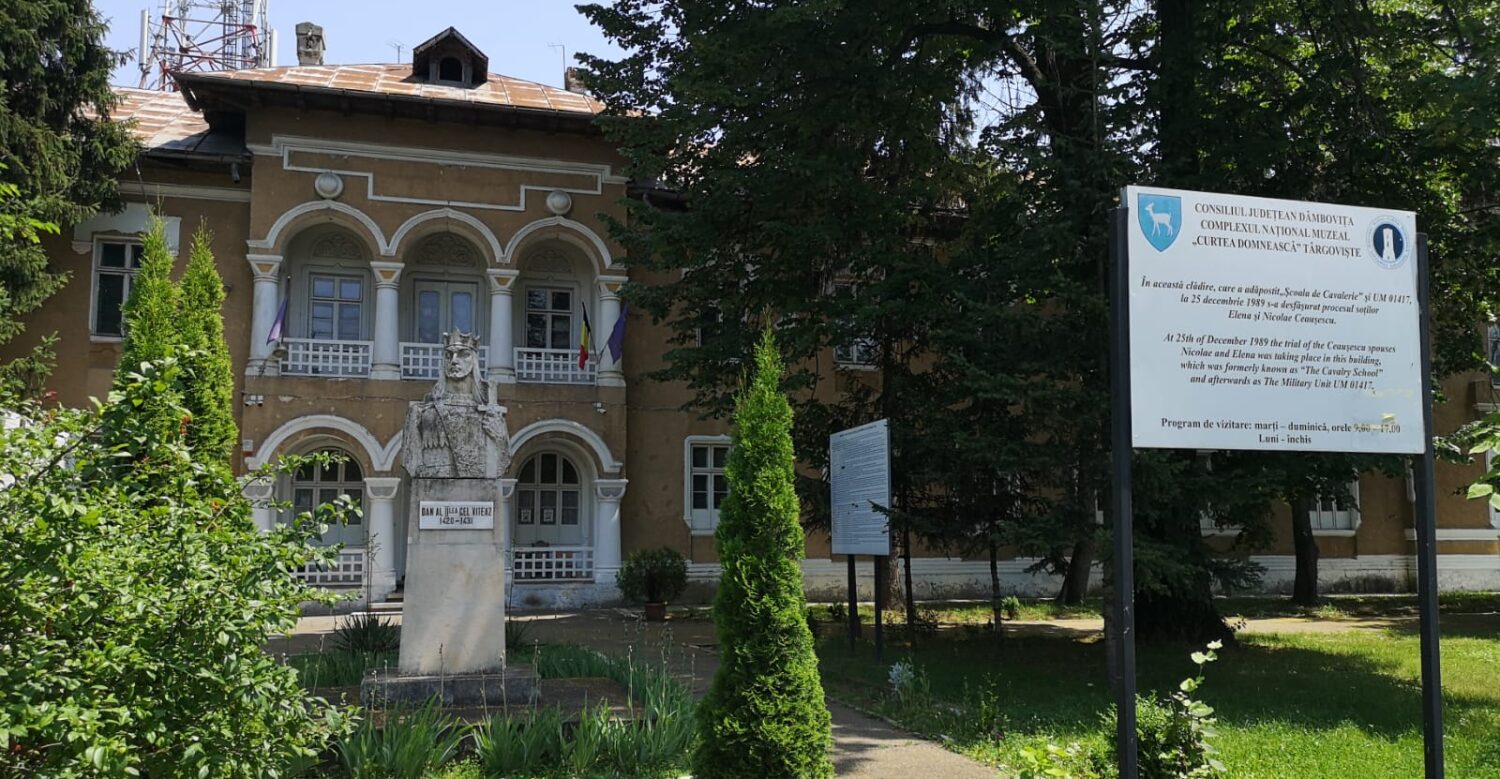
Through the Curtea Domnească National Museum Complex of Târgovişte, Dâmboviţa County Council manages priceless heritage sites, such as the Curtea Domnească Monument Ensemble, the Chindia Tower, the Paraclis Church, and also the Former Cavalry School.
Although in a visible state of degradation and in need of important intervention works in terms of restoration, conservation and sustainable use, the building of the Former Cavalry School has great historical significance.
At first, the Cavalry School of Târgovişte operated here. It had been established as a result of a cession deed that was signed by a former Mayor of Târgovişte, Dimitrie Athanasiu, and the Ministry of War’s delegate, Major D. Dragotescu. Based on the cession deed, a plot of land of 102 hectares and 8,198 square meters, which was “located at the top of the city”, was granted by the municipality to the War Administration, in order to construct the buildings that would be parts of the Cavalry School and a ground for training and running.
Subsequently, on 20 October 1907, the foundation stone was laid here for the building that, from 1910 on, would be the School of Cavalry Officers from Târgovişte.
The Revolution of December 1989 marked the history of this place for good, because in the building of the former Cavalry School – where, at that time, the UM 01417 military unit used to operate – both the trial of the Ceausescus and their execution took place. After the Curtea Domneasca National Museum Complex of Târgovişte took over the building, the exhibition ’Metamorphoses of a place of memory: from the chivalry of the Officer School Ferdinand I to the profane space of trial and execution of spouses Ceausescu and the end of the totalitarian regime in Romania’ was open to public here.
Therefore, considering the great historical significance of the building – which is representative for several eras and particular moments which marked the history of the Romanian people, as well as the duties of the Dâmboviţa County Council according to Law no. 422/2001 on the protection of historical monuments, in order to ensure the necessary framework for protection and conservation of heritage objectives – it is necessary to carry out intervention works with a view to its sustainable capitalizing. Nevertheless, due to Dâmboviţa County Council’s big amount of duties, the local budget is insufficient to deal with all aspects which both the social, economic, and cultural development of the county and the local cohesion involve.
Therefore, attracting European funds for investment “Conservation, restoration, capitalization of the former Cavalry School building in order to strengthen the cultural identity of Dâmbovița County” is an alternative that will allow a sustainable capitalizing of this class B historic monument.
The project has been eligible within RO CULTURE Program – CALL 1 – Restoration and revitalization of historical monuments, in accordance with the EEA and Norwegian Grants Regulation 2014 – 2020 / Norwegian Regulation 2014/2021 and Government Emergency Ordinance 34/2017 on the financial management of non-reimbursable external funds related to the European Economic Area Financial Mechanism 2014 – 2021 and the Norwegian Financial Mechanism 2014 – 2021.
The general objective of the project is the conservation, restoration and capitalization of the Cavalry School Building in order to consolidate the cultural identity of Dâmbovița County in an innovative way, through an integrated approach.
The specific objectives of the project:
-
Conservation and restoration of the Former Cavalry School building from Târgoviște, so as to preserve its uniqueness and historical significance, by carrying out intervention works on the structure, architecture of the building’s facilities.
-
Capitalization of the heritage objective The former Cavalry School by making use of its assets with a view to host events like ’Cultural Cafe’, which can trigger economic and social development.
-
Promoting the Former Cavalry School by means of national and international cultural events, and making an animated film with the theme “History of Romanian Cavalry”.
The main activities of the Project:
- Conservation and restoration of the historical monument the Former School of Cavalry
- Valorization of the restored historical monument.
Project results:
- A building, that is also a historical monument, will be restored and capitalized culturally and economically
- A 35 percent increase of the annual number of visitors or of the people attending cultural activities
- 6.5 jobs will be created
- the capitalization plan of the cultural heritage building will be implemented
- 16 specialists whose skills / expertise will be developed at their workplaces
About EEA and Norway Grants
The European Economic Area (EEA) and Norway Grants represent the contribution of Iceland, Liechtenstein and Norway to reducing the economic and social disparities in the European Economic Area, and to strengthening the bilateral relations with the 15 beneficiary countries in the Eastern and Southern Europe and the Baltic States.
These financial mechanisms are based on the European Economic Area Agreement that reunites the EU member states and Iceland, Liechtenstein and Norway, as equal internal market partners.
The three countries have provided a total amount of €3.3 billion through consecutive grant schemes, from 1994 and 2014. Furthermore, they provided €2.8 billion in 2014 – 2021 funding period.
For more details on the EEA and Norway Grants, please visit: www.eeagrants.org & www.eeagrants.ro
The Ministry of Culture, through the Project Management Unit, is implementing the RO-CULTURA Programme. Its overall aim is to strengthen the economic and social development through cultural cooperation, cultural entrepreneurship, and cultural heritage management. The Programme budget is approximately €34 million.
For more details, please visit: www.ro-cultura.ro